
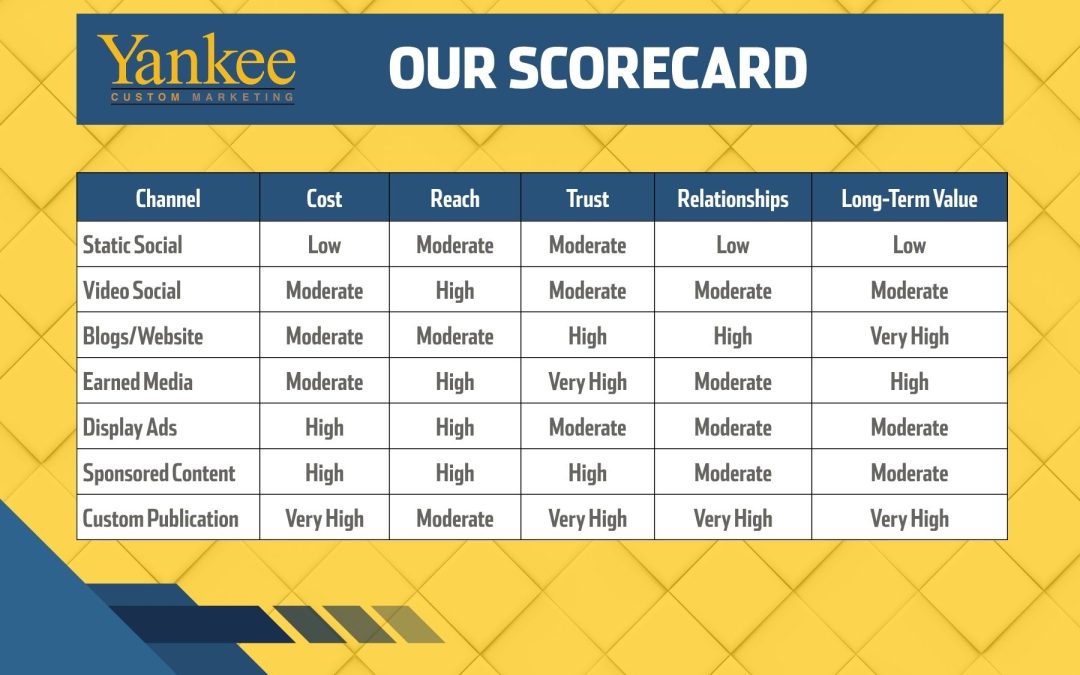
Weigh the tradeoffs to create a strategy that works best for you
With marketing budgets tightening as business costs and inflation rise, teams need to justify every dollar. Cutting back to only low-price items might trim spending, but doing so without a solid strategy may cost you in lost attention and customer relationships.
What makes the most sense for your budget might not work for another organization. From social media and content marketing to earned media and print publications, there is an array of channels to showcase who you are and what you offer to customers.
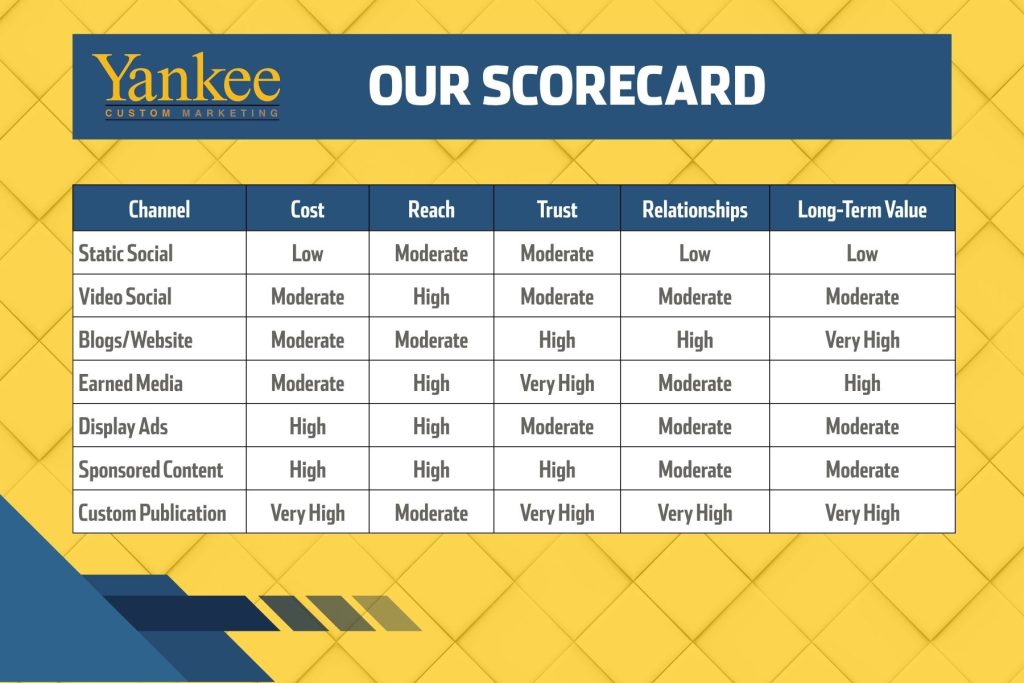
Yankee Custom Marketing (YCM) works with dozens of organizations to craft marketing strategies that are tailored to needs, goals and budgets. We often encourage clients to think about marketing investments across six dimensions: cost, reach, trustworthiness, authenticity, relationship-building and long-term value.
Each channel offers a different combination of these dimensions. Understanding those tradeoffs can help your organization build a strategy that matches your marketing budget and meets your goals.
The smartest strategy isn’t choosing the best tactic. It’s choosing the right mix for you.
Build your marketing strategy around an investment spectrum
A low-budget way to build a presence
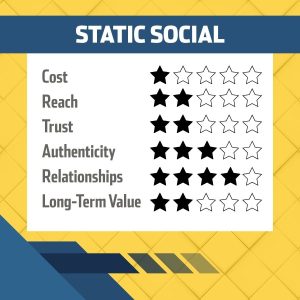
The lightest commitment and cost entry point for most organizations is typically social media. In most cases, it’s free to open an account and very quickly have an online presence.
Regular posting ensures that if someone seeks out your page, they’ll see that your business is active. It is also a good space to highlight quick updates like special events or unplanned closures, while also providing opportunities for connection and brand awareness.
According to HubSpot’s 2025 report, most marketers post a few times a week, depending on the social media platform. TikTok, Instagram and X (Twitter) see higher post frequency, while sites like Facebook and LinkedIn are more like a few times per week. B2B organizations tend to post more frequently than B2C.
Sharing a text and image post costs nothing up front except for someone’s time. However, you’ll find that when you post consistently to start seeing some traction and you start to get messages and comments you can reply to, it can snowball into a larger time commitment.
As an affordable and low-barrier starting point, social media is a crowded space for the attention economy. Adjustments to back-end algorithms make it challenging to plan for what sort of audience will see your content, even if they are following you. Boosting posts, at an additional cost, can expand that reach.
Increasingly, social media sites prioritize video, which means that type of content organically reaches a wider audience. Video content is also seeing higher engagement rates. However, video posts tend to have higher productions costs and creation time needs.
Boosting posts, at an additional cost, can expand the reach of static and dynamic posts.
Overall, social media delivers an affordable starting point and brand visibility, and supports existing relationships. It can be easy to repurpose content to social media. However, audiences don’t always see social media as trustworthy as other media formats. Posts have a short shelf life in a competitive environment with limited organic reach. You also don’t own your audience on a social media platform, but “rent” it from the social media company.
Substantial content with an economical budget
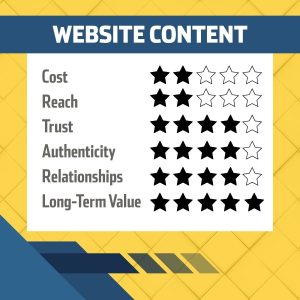
With a moderate increase in marketing budget and time commitment, you can create website content and blogs that help boost search engine optimization (SEO) of your website; and position your organization as an experienced resource to form a foundation for additional reach via social media or email marketing.
As with social media, high-quality content that showcases your expertise will offer the best engagement and longevity. You should structure content clearly so that search engines and AI-powered search tools can easily identify and summarize your expertise.
Drafting blogs and digital resources may require more time than you spend on reporting, writing and editing, but you don’t have to create them as frequently as social media posts to see results. Regular weekly or monthly posts are often enough to keep your website up-to-date and drive fresh traffic. You can refresh evergreen topics multiple times to keep your website relevant.
Online content offers the opportunity to build a website that serves as a resource for your customers — answering their questions and showing ways they can benefit from your product or service.
One limitation of website content is that it is not automatically pushed out to an audience. Potential customers must be searching for something that your content can fulfill, or you have to reshare the content on social media and email. Email newsletters are among the highest return-on-investment marketing channels out there, so having fresh content on your website to attract email readers is valuable. Once you capture an email address, you own that information and can continue to develop a customer relationship with them (unless they unsubscribe).
Converting an audience into customers can take time. However, audiences may view web content as more trustworthy than social media alone, and you are likely to reach people further down the sales funnel who are already searching for a solution or those who are on your email list.
Unlike a social media post that disappears from feeds in days, a strong article can continue generating traffic, answering questions and supporting sales conversations for years.
Deliver your message by traditional media
If you are in an industry where trustworthiness and credibility are primary conversion drivers for customers, you may want to explore options for placing your content in magazines and newspapers.
While trust in traditional media has waned a bit over the past decade, data from the Pew Research Center shows that consumers still trust local news outlets at nearly twice the rate of social media (70% vs. 37%), while national news outlets fall in the middle (56%).
You can share your organization’s content through typical display advertising, find ways to repurpose blog materials into press releases for earned media placement or pay for guaranteed placement as sponsored content.
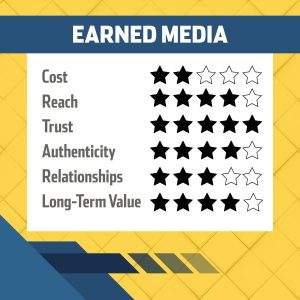
Earned media is when a reporter interviews a representative of your organization as a source for a story. Sometimes, this is a story specifically about your company — it’s often a follow-up to a press release — or sometimes, you provide expertise on a topic that is broader than your company.
Here’s one of the biggest benefits to earned media: Since editorial oversight is retained by the publication, not your company, there is higher trustworthiness with readers. It also doesn’t require payment, but it can be time-intensive to reach out to media organizations to find even one that can highlight you. You also have less control over the narrative as journalists don’t typically share draft copy with sources.

One way to guarantee inclusion in a publication is through sponsored content. This is a paid placement, much like a regular ad, but formatted in the same style as a newspaper or magazine’s other articles. Audiences tend to value sponsored articles more highly than traditional display advertising because they provide useful information rather than interrupting the reader’s experience.
Publication must clearly label sponsored content to comply with advertising disclosure requirements and maintain audience trust. While viewers may not trust sponsored content quite as much as independently earned mentions, a position in a traditional media format extends its credibility. Transparency about sponsorship is a key part to maintaining high trust. Consumers don’t want to feel like you’re trying to trick them.
When you provide engaging content with authenticity and transparency, readers get your message in a tone that fits your brand style, but with the perceived backing of an established media company. You get access to that media outlet’s audience, but you don’t get access to the contact information behind it.
Enduring, high-impact content comes with investment
If your organization is looking to reach customers with high-quality, custom content that they’ll sit with for nearly an hour rather than a few seconds, then it may be time to consider producing a custom magazine. This is among the higher cost options you can consider for your marketing strategy (but there are ways to lessen the financial impact).
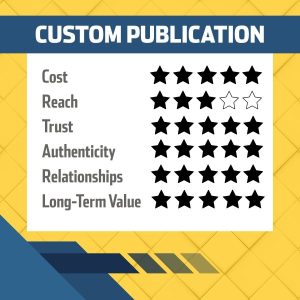
Consider this product when you have a defined audience and enough content to sustain it; your company is at a point where relationship-building is more important than immediate lead generation; and you have long-term marketing goals.
Print carries an inherent signal of investment. Readers understand that producing a magazine requires intention, resources and commitment. That often translates into higher perceived value and legitimacy.
Worldmetrics found that people who sit down with a magazine spend an average of 41 minutes with it, and 83% of magazine readers say it helps them relax and unwind. When your organization invests in a magazine, it pays off in distraction-free attention in a format that is trustworthy and aspirational.
By creating your own publication, you control the whole narrative with plenty of space to tell the story of your “why” and provide content that is valuable to your customers. This is central to relationship-building and brand loyalty. A magazine has a longer shelf life and has greater reach than just the number of copies printed. Page 4 Media reports that the average pass-along rate for magazines is six readers per copy.
With a magazine, you can target specific demographics by delivering copies directly to them, pass them out at industry events or opt for accidental exposure through welcome centers, waiting areas or newsstands. Digital editions extend reach beyond physical limitations.
The benefits of a magazine carry beyond the print product with an omnichannel marketing strategy. All articles in the magazine can be repurposed as website blog content and social media posts. This is all content you continue to own. You also potentially own the list of contacts, too, depending on your distribution model.
The challenges of magazines are the more complex production logistics, with longer timelines and a higher up-front cost. Sponsorships or advertising can help offset your costresponsibility, but that may require more time and coordination from your team.
For some organizations, especially those focused on rapid lead generation or highly transactional sales, other channels may deliver a stronger return on investment.
Finding the right marketing strategy for your organization
The most effective marketing strategies rarely rely on a single tactic. A blog becomes social content. A feature article becomes a media pitch. A sponsored story introduces new audiences to your brand. A custom publication deepens existing relationships.
The question isn’t whether one approach is better than another. It’s whether you’re investing in the right combination to achieve what matters most to your organization.
Understanding what each channel truly delivers can help you spend your marketing budget with greater confidence and purpose. YCM partners with clients to go over all the options to find a mix that makes sense. Whether you’re looking to explore digital or print channels, or both, YCM focuses on outcomes rather than the highest cost option.
YCM can help clients across the entire spectrum, from a handful of social posts to a full custom publication, while building a cohesive strategy that connects each piece together.